[UNEDITED] Shadowbox Claims: Fact or Fiction? Truth or Consequences?
Note from DCC: In the process of editing the story down for publication in Decaturish, some details were omitted. What follows below is the original, unrevised version.
While it’s true that data center development has become a flashpoint in DeKalb County and across the country, a true democracy vests power in the people through a system of elected representation. The community has spoken. The overwhelming majority of OUR RESIDENTS DO NOT WANT HYPERSCALE AI DATA CENTERS or CAMPUSES in DEKALB! A genuine partnership with our community recognizes and respects the democratic process.
Yes, Shadowbox, the reality of data center development is “more nuanced.” Our community does not have to settle for Shadowbox’s "unwavering standard" submitted here as a Letter to the Editor, but written as blatant, brazen propaganda. Unfortunately, data center developers often use these deceptive tactics to conceal the devastating negative community impacts so they can secure approvals from local leaders.
History of Partnership Shadowbox Studios (formerly Blackhall Studios, owned by Ryan Millsap) has a dubious history with DeKalb County
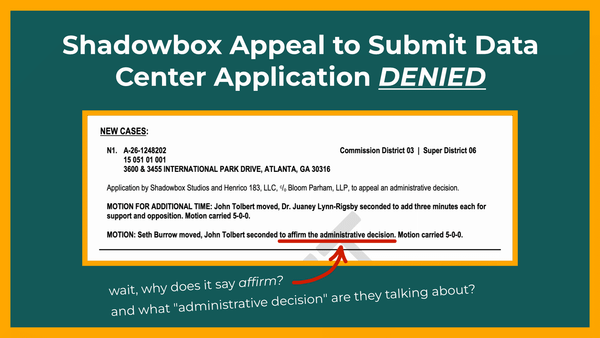
Shadowbox claims they have worked “collaboratively” with DeKalb. Yet, just three months ago, Shadowbox Studios sued DeKalb County, claiming they have a “right to build” a [hyperscale AI] data center [campus] here, even though no plans were ever approved. In their lawsuit, Shadowbox alleges that the Moratorium on data centers is invalid, and claims they spent $30 million on data center development, when in fact, they spent substantial amounts of money on their planned movie studio expansion, which was approved in 2021. Then, in July 2024, the Shadowbox Board of Directors decided to “pivot” to a data campus because the movie industry wasn’t as lucrative. Shadowbox failed to submit a formal application to the DeKalb Planning Department until March 2026, nine months after the Moratorium was enacted by the Board of Commissioners (BOC). The DeKalb taxpayers are not responsible for Shadowbox’s bad business decisions.
It appears that Shadowbox seeks a quid pro quo for their gratuitous $5M investment in the Atlanta metro area (inside and outside DeKalb). As for the $1.5 million debt payoff for the Michelle Obama Park, could the “anticipated benefactor” be Ryan Millsap, whom DeKalb County recently sued for the unpaid $1.5 million connected with the land swap deal involving property near Shadowbox? The same Ryan Millsap who has reportedly made derogatory comments regarding race and ethnicity including complaints about “f**king” Black people”? (Carr and Jordan, “A Powerful Atlanta Movie Executive Praised for His Diversity Efforts Shared Racist, Antisemitic Sentiments in Texts”, April 18, 2024)? Coincidence?
Community Outreach and Engagement
True “transparency” means providing consistent and accurate information, not vague promises and propaganda. Shadowbox has framed opposition to data centers as a simple binary "yes or no" and dismisses legitimate citizen concerns about our shared resources, local infrastructure, and quality of life. "Responsible development" should meet the needs and desires of the people. This is what Shadowbox community outreach and engagement looks like:
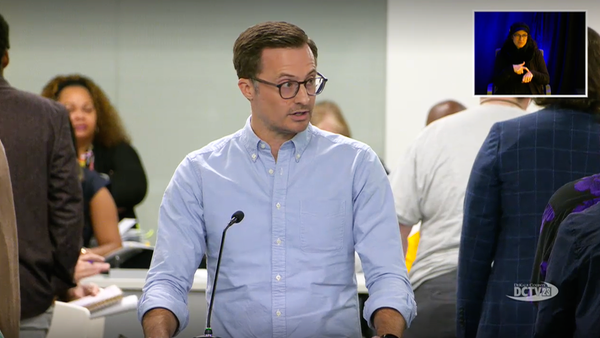
In 2023, Shadowbox engaged former DeKalb County Planning Director Andrew Baker as a private consultant, held private discussions with DeKalb County planning staff, and did not fully engage the community until after filing a lawsuit against DeKalb County on August 5, 2026. Then, on August 27th, a year after intense public opposition to data centers was in full motion, Shadowbox held its first countywide community meeting by invitation only, but few neighboring residents were there. At the meeting, Shadowbox did not fully disclose the size and scope of the proposed data center development, but presented a schematic of five buildings on a 155-acre site. Although Shadowbox executives stated they would be willing to conduct any studies the community requested, they later changed their tune. DeKalb residents have been requesting that the BOC commission an independent, third-party health and environmental impact study for the past several months. Yet, at the November 10th DeKalb BOC meeting during public comment, Shadowbox Chief Development Officer Jeff Weber took residents’ precious time to lecture us on how we did not need that study. Weber self-servingly asserted that we should study the impacts of data centers and how we can “mitigate” them (DeKalb County BOC Meeting, Public Comments, November 10, 2026). The arrogance! Why should we have to accept any negative effects of a data center campus to appease Shadowbox? The BOC voted 5-2 to withdraw Commissioner Ted Terry’s proposal for an independent health and environmental impact study on the same day.
If Shadowbox seriously values community input, they would withdraw their lawsuit and accept that the community does not want AI data centers here. People and developers are not equal stakeholders. The desires and demands of the people should outweigh the speculative visions of these developers.
Electricity
Data centers pay a discounted industrial power rate and residential customers pay more. Shadowbox has asked Georgia Power to reserve 651 megawatts of electricity for its planned hyperscale data campus. This is more power than the entire city of Columbus, Georgia uses. Data Centers may be required to pay for the power transmission upgrades at their facilities, but historically, Georgia Power residential customers pay for power generation. Georgia citizens may be paying for the Plant Vogtle nuclear power plant for generations to come; the same is likely to hold true for the ongoing data center power expansion (Durand, “Data center expansion in Georgia has implications for consumers’ power bills”, July 31, 2026). Forbes estimates that existing data centers have already raised wholesale electricity prices by 3% to 5% nationally, with larger effects in major data center corridors. Under its moderate buildout scenario, wholesale prices could rise about 20% by 2028. Under a high-utilization scenario, the increase could approach 50% (Kay et al., “Processing Power: The Effect of Data Centers on Wholesale Electricity Markets", October 9, 2026).
Water
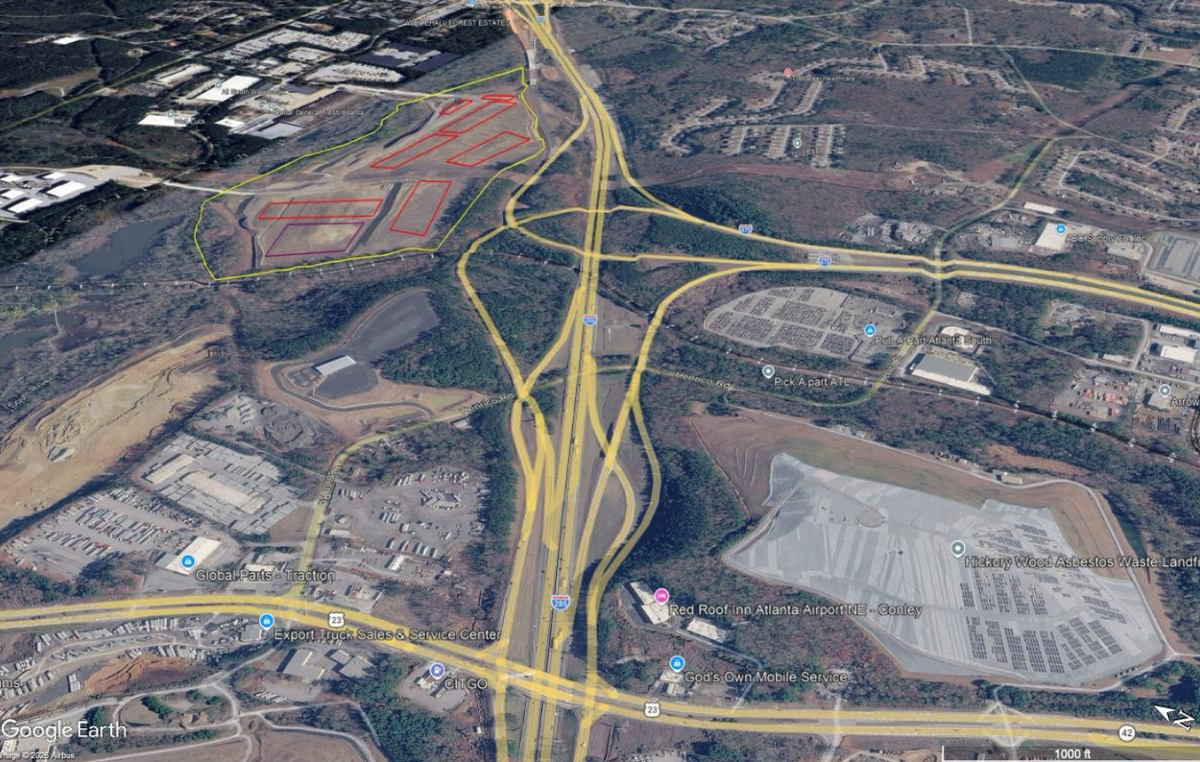
DeKalb County has been under a Federal EPA Consent Decree since 2011 related to contamination of our waterways by sewage. Shadowbox stated at its August 2026 invitation-only “community” meeting that they were planning to use an “immersion cooling system” for the five multistory data center buildings. Immersion cooling utilizes “forever chemicals” (PFAS) which will require less water but will still continue to use water. These fluids will need to be replaced periodically and cannot be disposed of in our sewer systems or stormwater systems as they deplete oxygen from the natural waterways, harming the living creatures (Martin, “PFAS Exposure for People and Wildlife”, April 10, 2024). Dangerous additives cannot be removed from water treatment plants, and could cause more sanitary sewer overflows in DeKalb’s broken water infrastructure. Trucking in enough water for the data center campus from unnamed sources will only deplete the water supply for other communities. Since Shadowbox has not fully disclosed the size or capacity of these five multistory buildings, comparison of water use to a single McDonald’s is without merit. What’s worse, the proposed Shadowbox site adjoins an environmentally sensitive DeKalb County park and an extensive wetland system along the South River, which could be destroyed by this massive data center campus.
Air Quality
Shadowbox has only released conceptual project plans, so their comparisons to other land uses lack specific metrics. At the August community meeting, slides were presented showing how heat will be removed from the data center servers, then released into the surrounding air through heat-rejection units, which blankets the surrounding areas with “heat island” effects (Tangermann, “Massive Data Center Cooks Nearby Residents Alive Amidst Deadly Heatwave”, June 26, 2026). Diesel generators discharge pollution into the atmosphere, further compromising air quality. Shadowbox claims this would be comparable to the air pollution emitted by I-285—we don’t need more pollutants comparable to I-285.
Neighborhood Impact
Shadowbox Studios claims they are suing us to protect THEIR property rights. But what about OUR rights? Even though Shadowbox claims their data center campus will use less water, they fail to address the evaporative effects of chemically-treated water or the “heat island” effects resulting from a closed-loop immersion cooling system. Nor do they address the negative effects of data center noise and infrasound vibration, which runs wildlife, migrating birds, and people away from this environmentally sensitive area. And what happens if there is a fire at the proposed Shadowbox 155-acre site? (Remember BioLab in Rockdale County.) The closest fire station is currently ill-equipped to respond to industrial scale fires. Finally, a recent study shows that people living near data centers can suffer a loss in property values by as much as 7.2% (Energy Institute at Haas, “Data Centers Lower Nearby Housing Values”, September 2026). As for our electricity bills, Shadowbox has no control over Georgia Power energy rates, so they are in no position to promise home power bills won’t increase.
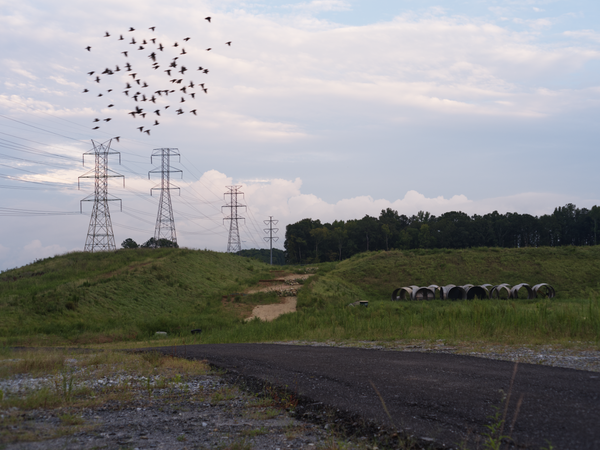
In short, Shadowbox wants to build a hyperscale AI data center campus on property located over the South River and across the street from Intrenchment Creek Park, with no regard for our wetlands, greenspace, or nearby neighborhoods; with no regard for our residents’ health and welfare, property values or quality of life. But why should they care? Shadowbox CEO Peter Rumbold doesn’t live here.
After gambling on the film industry with their studio expansion and coming up short, Shadowbox is now taking chances on one of the largest economic bubbles in U.S. history, rivaling the dot-com and subprime mortgage bubbles in scale (Roberts, “The AI bubble and the US economy”, October 14, 2025). When the bubble bursts, we could be left with a contaminated data center wasteland.
Community Benefits
Shadowbox has yet to secure a tenant for their data center campus, so they cannot commit to future revenue streams, payments to the County, or the number of jobs that could flow from an unidentified third-party’s operations. According to their website, community “Economic Benefits” were provided by the Economic Impact Group, LLC with the following disclaimer: “These numbers are all estimated amounts based on the project, as currently scoped.”
Shadowbox projects that its proposed data center will generate $133 million in annual property tax revenue to the County. They suggest this could “fund water and sewer improvements, roads, and community redevelopment.” Yet, the County has been under a federal consent order since 2011 for failing to maintain its sewer infrastructure. The deadline for repairs has been extended twice. Now, repairs are not expected to be completed until 2037. The County has already approved a “10-by-10” increase in our water rates – a 10% rate hike every year for the next ten years – to fund the required repairs (Johnson, “No Water to Bathe or Drink: Black DeKalb Residents Go Months Without Service”, November 12, 2025). Stormwater fees were also increased earlier this year for the same reason. Clearly, the problem is no longer merely financial. DeKalb residents are also paying a one-cent SPLOST (Special Purpose Local Option Sales Tax) to fix our roads, and have been paying an additional one-cent MARTA tax for more than 50 years with negligible transit options and no transit-oriented economic development to show for it in South and East DeKalb. We should not have to suffer the negative impacts of data centers to pay again to meet the County’s financial obligations.
Why is Shadowbox Planning a Data Center?
Shadowbox is likely betting on receiving lucrative State tax incentives to build their data center campus. In 2021, Blackhall Studios was sold to Commonwealth Group (a private equity firm) and was subsequently rebranded Shadowbox. In April 2022, the new owners received approval for revenue bond commitments of up to $406 million from Decide DeKalb (the county economic development authority) to expand the movie studios. The bonds were based, in part, on a promise of 2,400 new jobs. Shadowbox now offers only an estimated “275 permanent high-paying positions” at their proposed data center campus, a whopping 89% less than what was initially promised to expand the movie studios. Their investment in the community looks more like a classic bait and switch. After gambling on the film industry with their studio expansion and coming up short, Shadowbox is now taking chances on one of the largest economic bubbles in U.S. history, rivaling the dot-com and subprime mortgage bubbles in scale (Roberts, “The AI bubble and the US economy”, October 14, 2025). When the bubble bursts, we could be left with a contaminated data center wasteland.
In response to The People’s Data Center Moratorium, Shadowbox filed a lawsuit in an attempt to impose their will against intense and growing citizen opposition. That litigation is still ongoing. If Shadowbox is trying to “earn our trust,” they missed the mark.